Rise to Peace

Editor’s note: This article was originally published on September 12, 2021 and was updated on October 23, 2026 to clarify terminology and framing. Rise to Peace distinguishes between religion and violent extremist organizations that invoke religious language, identity, or ideology for political ends. This analysis focuses on specific organizations, political movements, and local conditions—not faith communities.
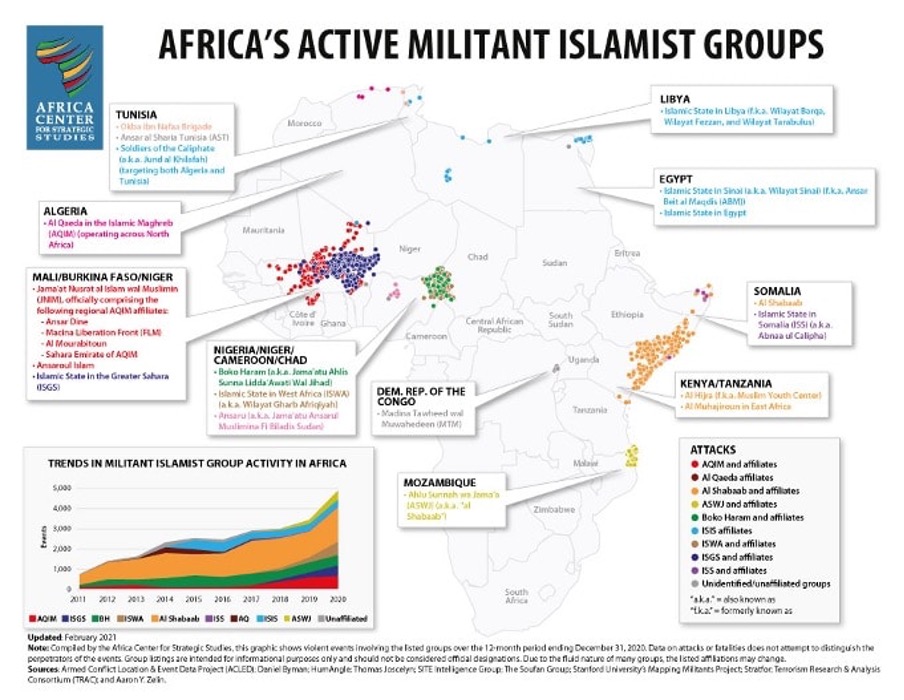
Across parts of Africa, violent extremist organizations have expanded by exploiting political instability, weak governance, unresolved local conflicts, economic hardship, and distrust of state institutions. Groups such as Boko Haram, Al-Shabaab, Ansar Dine, and Al-Qaeda-linked networks have operated in very different environments, and their success cannot be explained by religion or religious demographics alone.
The more useful question is how particular organizations gain influence in particular places. In many cases, armed groups adapt to local grievances, provide forms of protection or dispute resolution, exploit criminal economies, and present themselves as alternatives to governments that communities view as absent, abusive, or ineffective.
Governance Gaps Create Opportunity
Decades of conflict across parts of West, Central, East, and North Africa have weakened institutions and created areas where governments struggle to provide security, justice, services, and economic opportunity. When central institutions cannot meet basic needs, other actors—including local militias, criminal networks, tribal structures, armed political movements, and extremist organizations—can step into that space.
The original 2021 analysis cited data from the Global Terrorism Index showing the scale of extremist violence in sub-Saharan Africa over the preceding two decades. Those numbers reflected a broad range of organizations and conflicts, not a single religious cause. The central lesson remains that extremist violence develops through a combination of political, economic, security, and social conditions.
Organizations such as Al-Shabaab, Boko Haram, and Al-Qaeda-linked groups in the Sahel have at times created forms of shadow or para-state governance in areas where state authority is limited. This can include taxation, dispute resolution, coercive security, recruitment networks, and control over movement or commerce. These structures do not necessarily indicate genuine community support; often they combine coercion with the strategic use of local grievances.
Local Conditions Shape Recruitment
Recruitment patterns differ significantly from one region to another. In parts of the Sahel, armed groups have benefited from weak state presence, trafficking routes, competition over land and resources, and long-standing tensions between communities. Criminal economies that existed before the arrival of extremist organizations can become sources of revenue, mobility, and influence for armed actors.
In Somalia, Al-Shabaab has operated within a political environment shaped by decades of state weakness, conflict, corruption, clan competition, and insecurity. Its ability to recruit and exercise influence cannot be reduced to religious belief. The organization has used a combination of coercion, political messaging, taxation, local dispute resolution, and military force to maintain influence in areas where government institutions remain contested.
In Mali, Niger, Burkina Faso, and neighboring areas, armed organizations have also exploited disputes between communities, abuses by security forces, weak rural governance, and perceptions that national institutions do not protect or represent marginalized populations. In some places, groups have offered protection or access to weapons. In others, intimidation and violence have generated resistance from local communities.
Religion Is Not a Sufficient Explanation
Religious identity by itself is not a reliable explanation for extremist violence. Countries with similar religious demographics can experience dramatically different security outcomes. What matters is the interaction between political institutions, local grievances, armed conflict, economic opportunity, community relationships, and the strategies of specific organizations.
This distinction is important. When terrorism is described through the label of an entire religion, analysis can become less precise and communities can be unfairly associated with the actions of violent organizations. A stronger analytical approach identifies the organization, its political objectives, the ideology it promotes, the communities and grievances it seeks to exploit, and the conditions that allow it to operate.
Ideology Matters, but Context Matters Too
Ideology can still play an important role. Extremist organizations use ideological narratives to justify violence, define enemies, recruit followers, and create a sense of political or social purpose. But ideology does not operate in a vacuum. The same narrative will have very different effects depending on local history, governance, economic conditions, security, and community relationships.
For researchers and policymakers, this means examining specific ideological movements rather than treating a religion as a single political category. It also means distinguishing between ordinary religious belief, political activism, nonviolent ideological movements, insurgency, and organizations that deliberately use violence against civilians.
Policy Implications
Military pressure may sometimes disrupt armed organizations, but security operations alone rarely resolve the conditions that allow extremist movements to regenerate. Effective responses should also strengthen accountable local governance, improve access to services and justice, reduce abuses by security forces, support peaceful mechanisms for resolving disputes, and expand credible economic and political opportunities for communities that have been marginalized.
Local governments and civil society organizations are especially important because the drivers of violence are not identical across countries—or even across neighboring districts. Policies designed for Somalia cannot simply be transferred to the Sahel, and an approach that works in one community may fail in another.
Conclusion
Violent extremism in Africa is not the product of a single religion, population, or ideology. Specific organizations succeed when they are able to exploit weaknesses in governance, unresolved grievances, insecurity, economic exclusion, and local political conflict.
Understanding those differences leads to better policy. Instead of broadly associating terrorism with a faith community, analysis should identify the organization involved, examine the ideology and political goals it advances, and understand the local conditions that make recruitment and violence possible. That approach is both more accurate and more useful for preventing violence.
Africa Rise to Peace blog #Africa #Islamist extremism #Jihadism
About the photoAfrica’s active militant Islamist groups in 2021 (Source: Africa Center for Strategic Studies)