
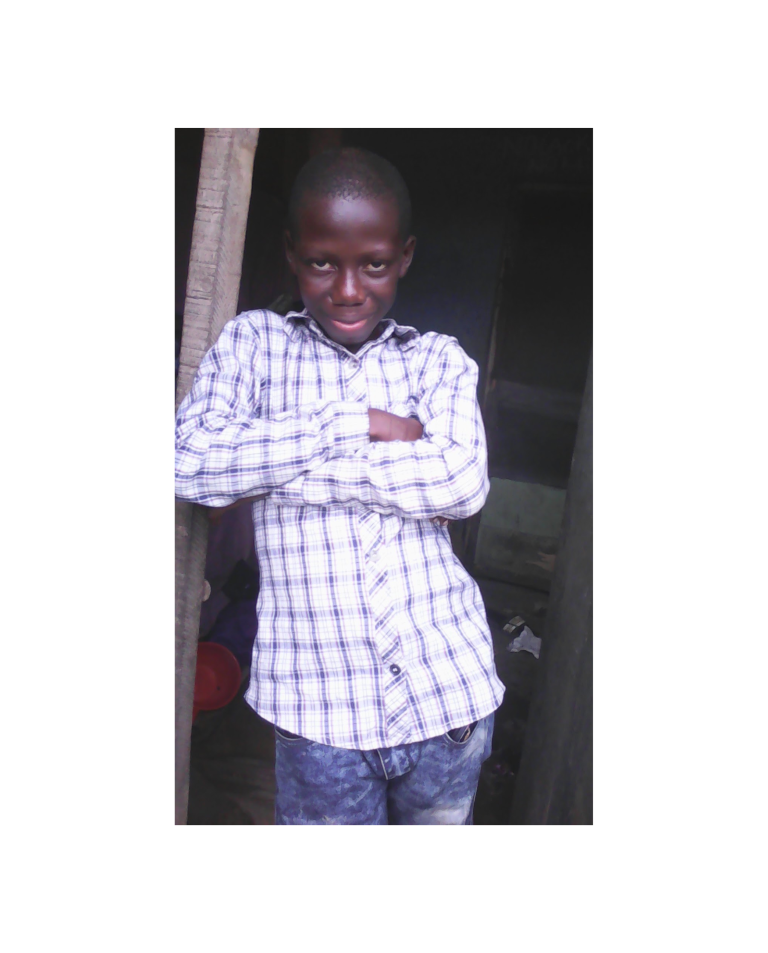
“A photo of me as a child, around the time 11 September was still just a headline my guardian and his friends spoke about — something I hadn’t yet learned to feel.”
I was born on 11 June 2002, so 11 September never belonged to my memory the way it does for people who watched it happen live. It arrived in my life the way most of history arrives for children: secondhand, filtered through adults who already knew what it meant and were still deciding how to feel about it. For years, it was just a name on a page, something that returned every year like a date on a calendar nobody explained to me.
My guardian, a man not related to me by blood but trusted to raise me, used to send me to the news vendor for the morning paper. I was only ever hunting for football scores, flipping past everything else to find out who had won and who had missed a penalty. But every year around this time, I would notice him and his friends drop into a different kind of conversation, quieter and more serious than their usual talk, about a death toll, about an economy in America that had cracked and somehow reached all the way to Nigeria. I did not understand it. I filed it away as something adults talked about, and children were not meant to care about yet. Looking back now, I think that was the first lesson, long before I had language for it, that events in one part of the world do not stay there. They travel, quietly, through prices and jobs and the mood of men reading newspapers on a Nigerian street corner.
That changed when I got to the Federal University of Oye-Ekiti to study Peace and Conflict Studies. In a course on regional geopolitics and terrorism, I finally met 11 September properly, not as an old headline but as footage. I watched a documentary that included the hunt for Osama bin Laden, and I saw, for the first time, the actual video of the hijacked planes and the moment one of them struck the World Trade Center. I had to look away from the screen. It was not something I could take in with my eyes fixed on it. What stayed with me afterward was not the collapse of two buildings, but the thought of how many ordinary people were inside them that morning, going to work the same way anyone goes to work, with no warning that their day would end that way. That was when the phrase “nearly 3,000 deaths”, which I had heard for years without feeling it, finally became real to me. A number I had walked past for two decades suddenly had faces I could not see attached to it.
It also unsettled something in me academically, not just emotionally. I remember sitting in that class thinking that this was not simply a story about America. It was a case study in how quickly the world can be reorganized by a single morning of violence, and how long the aftershocks travel. I had grown up watching my own community deal with smaller, quieter versions of that same truth, disputes over land and belonging that never made international news but still shaped who trusted whom and who did not. Studying 11 September gave me a vocabulary for something I had already sensed: that peace is not the default condition of human life. It has to be built, deliberately and continuously, or the space it should occupy gets filled by something else.
Studying peace and conflict in Nigeria means 11 September does not feel like a distant American wound to me. It feels like the opening chapter of a story my own country is still living through. The years after 2001 reshaped how the world talks about terrorism, but in West Africa that same era saw the rise of Boko Haram, a violence that has displaced millions and killed tens of thousands, mostly people who will never make an anniversary broadcast anywhere. When my own country lost the Chibok girls to global headlines for a season and then to the world’s short memory afterward, I understood something about which grief gets remembered and which gets left to fade.
What the world got right, I think, was refusing to let those attacks pass in silence. What it got wrong was treating terrorism mainly as something to be bombed out of existence, rather than a symptom of grievance, poverty, and broken belonging that has to be addressed at the root. Twenty-five years later, from where I sit, the lesson I would want us to carry is not just about airport security or military campaigns. It is that peace has to be built into communities before fear finds an opening, because by the time a bomb goes off or a plane is hijacked, the failure already happened years earlier, in whatever conditions let hatred take root undisturbed.
That conviction is part of why I started Peace Voyage, a youth-led effort to bring conversations about conflict and reconciliation to young people before grievance has time to calcify into something worse. I do not have the power to prevent the next 11 September, wherever in the world it might happen. But I believe the work of preventing it does not begin with intelligence agencies or airport scanners. It begins in classrooms and communities like mine, long before anyone is watching, in the quiet decision to build peace on purpose instead of assuming it will hold on its own.
https://www.britannica.com/topic/How-many-people-were-killed-in-the-September-11-attacks