Rise to Peace
Lasting peace needs more than responding to violence and conflict; it needs deeper prejudices that contribute to division in society to be addressed. Education can give an opportunity to challenge these beliefs, however, Artificial Intelligence is increasingly influencing how young children gain knowledge of the world and new challenges are emerging. UNICEF has highlighted concerns regarding AI and misinformation and the importance of developing children’s independent and critical thinking skills when it comes to deciphering what is real and what is AI. Ensuring that future generations are able to recognize and question harmful narratives is now an increasingly important part of long-term peacebuilding.
As children are now a larger part of the online community than ever before, they are being increasingly exposed to misinformation and discriminatory narratives that reinforce stereotypes leading to distrust between communities.
In 2021, UNICEF reported findings from the United Kingdom’s Commission on Fake News and Critical Literacy in Schools, which found only 2% of children had the critical literacy skills necessary for distinguishing real news from false information. This exemplifies the importance of educating young children particularly to evaluate information deeper, rather than accepting it at face value as factual.
As AI has emerged in society, it has introduced new and unique challenges. A study involving 37 children (ages 6-10) found participants performed at or below chance when distinguishing AI-generated content from human-created content. Despite AI not necessarily being capable of generating prejudiced information on its own, it has the ability to generate convincing misinformation, which raises concerns about how harmful narratives can be presented as credible to young people.
Prejudice and hostility towards various communities can undermine social cohesion by creating environments where discriminatory and extremist narratives gain acceptance. Preventing such an easily accepting attitude towards hateful narratives particularly in an online context is therefore an imperative step towards building peace among societies.
UNESCO identifies media and information literacy is necessary for strengthening resilience against online hate and mis/disinformation. Recognizing false information is unfortunately only a small part of a much bigger challenge. Children must also be encouraged to question why certain communities are portrayed negatively and consider perspectives that may oppose their own.
Evidence suggests that informative education contributes positively to preventative efforts. A UNESCO comparative study that examined 32 educational initiatives found encouraging critical reflection increases open-mindedness and positively influenced how participants responded to conflict. The research they did also identified reductions in support for violence among the results of some evaluated interventions.
The results from this study shows the potential for education to address some of the attitudes associated to recognizing misinformation particularly in regards to areas such as division and extremism. Critical thinking alone cannot guarantee peace however when combined with empathy and intercultural understanding, the foundations of long-term peace will be strengthened.
To promote lasting peace in an increasingly AI influenced world, educational approaches should extend beyond technological awareness and should actively try to bring communities together to understand each other.
- AI Literacy should be integrated into education on peace. UNESCO’s ‘AI Answers. You Decide‘ Initiative gives educators key resources that help young people evaluate AI generated information and make better informed decisions regarding its credibility. Schools should aim to build on such approaches and encourage students to further analyze misleading narratives regarding communities outside of their own and openly discuss how the information provided to them can contribute to prejudice. UNICEF’s research also indicates that media literacy education can improve young people’s ability to spot inaccurate information when presented to them and form their own conclusions regarding its credibility.
- Education should encourage empathy and constructive disagreement. For classroom activities to have a more positive impact on young peoples understanding of the world, it is recommended they should include the examination of different cultural perspectives, identify stereotypes and discuss peaceful responses to discriminatory narratives. UNESCO’s research on preventing violent extremism supports the value of critical reflection on educational activities that encourage constructive, non-violent responses to conflict.
- Successful peacebuilding education needs to go beyond the classroom. UNICEF emphasizes that children develop much of their understanding of AI via their families, peers and extracurricular activities. Therefore, school-based interventions alone are insufficient. Parents, legal guardians and community organizations should also encourage discussions about misinformation, prejudice and respectful engagement with others.
It should be further noted that these interventions should be age-appropriate, inclusive and regularly evaluated. UNESCO acknowledges that further research is needed to determine which educational approaches have the most positive impact and are most effective in the prevention of violent extremism.
Peacebuilding in society begins long before conflict emerges and by teaching children to recognize and challenge misinformation and prejudice as well as be respectful to different perspectives that may not align with their own, education can address the foundations of division before they are entrenched. While AI continues to shape the way future generations understand the world, combining digital literacy with empathy and peace education offers an opportunity for long-term sustainable prevention. Investing in children’s ability to question hate they may see online is an investment into the future of a more peaceful world.
Technology, Cybersecurity & Online Extremism
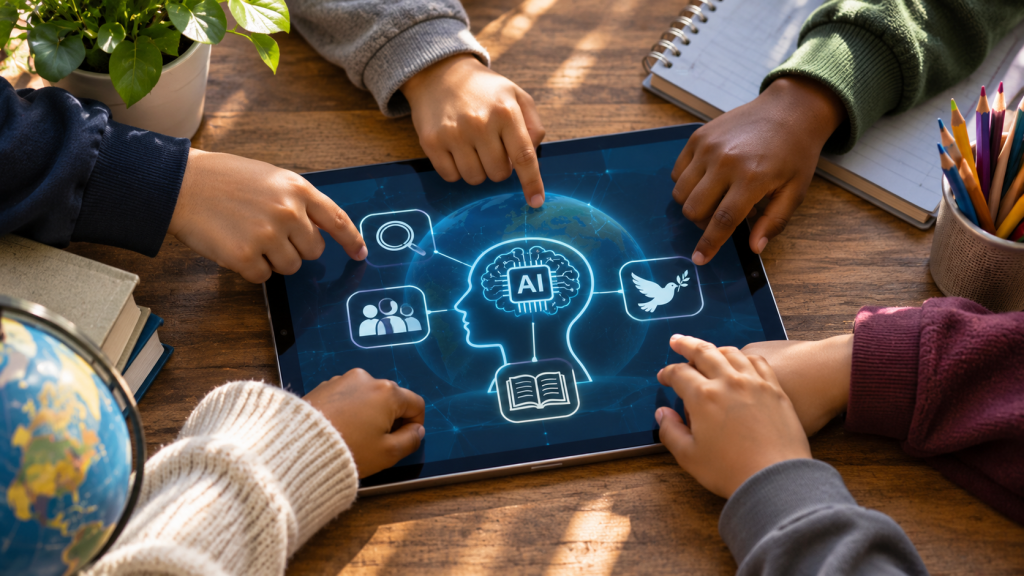
About the photoAI Illustrated image showing children's hands surrounding a tablet displaying 'AI' and other miscellaneous symbols of peace and education Photo: AI-generated image using OpenAI (2026)