 Rise to Peace

Why Does Russia Keep Fighting?
By Steven Ochoa
On September 18th, European news outlet Politico published an article that outlines the current reactions of European states and leaders towards the heightened tensions between them and Russia (Jack et al., 2026). It says that Germany is now preparing hospitals for a possible conflict, Lithuania updated its evacuation plans, Belarusian forces have staged large military maneuvers near Lithuania, Swedish and German forces have conducted joint exercises near the Swedish island of Gotland, and that NATO jets recently shot down a Russian drone over Lithuania. Regarding the leaders, it says that Polish Prime Minister Donald Tusk has warned that Russia “could send drones or missiles into the territory of NATO countries supporting Ukraine” in the upcoming months; French President Emmanuel Macron called for an emergency meeting regarding the situation in Iran and Ukraine, Finnish President Alexander Stubb told his country that it was “worth mentally preparing for something to happen” such as a Russian attack; and Lithuanian Foreign Minister Kęstutis Budrys said the country had the same intelligence as Poland about a potential Russian false flag.
These perspectives and actions of European leaders and their respective states are rooted in the fear of the conflict in Ukraine spreading to their borders. Is this worth paying attention to? The answer is yes because it highlights an increasingly deteriorating international security environment. Both Western European countries and Russia are preparing for a confrontation instead of de-escalating. Nevertheless, it’s still important to address the current state of the Russian mentality within its fight against Ukraine to understand what a potential resolution could look like and whether these fears are genuinely warranted. Coming to terms with the Russian perspective will allow these European leaders and those of the United States to address the root issues of the conflict. Thus, I will present an explanation of the Russian mentality with the purpose of arguing why they won’t stop this fight and will most likely win, assuming a full-fledged war doesn’t break out between NATO and Russia beforehand. In the end, I will offer a brief policy recommendation along with a prediction of how this conflict will turn out based on the current territorial standings of both Russia and Ukraine.
The Russian Mentality
The Russian military suffered an estimated half a million deaths between February 2022 and June 2026, and the monthly casualty rate is over 30,000 (Jones & McCabe, 2026). Domestically speaking, according to Russian officials and media outlets, Russia has also begun to see a dramatic increase in “serious” crimes due to the influx of weapons being brought into the country by soldiers returning from the battlefield, increased ethnic tensions, migration, and violence from its youth members (Goble, 2025). Regarding economics, Russia also now faces a large impact on its labor market due to labor shortages. It is projected to have a labor shortage of 2.4 million workers by 2030, given that young men are now more attracted, due to sign-on bonuses being offered, to earning more in the military rather than working in the civilian sector for smaller base pay; Russia now looks to other states such as India and Sri Lanka for migrant labor (Tefft, 2026).
On the Ukrainian side, there are an estimated 300,000 killed or wounded military casualties (Russia Matters, 2026. Despite the lower casualty rate on the Ukrainian side, former Ukrainian Defense Minister Mykhailo Fedorov, whose dismissal sparked several protests, claims that Ukraine is gradually and slowly losing (Hunder, 2026. Why? On paper, it may seem that Russia is losing to Ukraine and the Western nations providing economic and military aid; however, this isn’t necessarily the case. It’s important to understand that this is because Russia is fighting a battle that they believe is a response to an existential threat, and in their eyes this threat is NATO expansion. This perspective is not new and has been ingrained in their mentality for several decades, which in turn drives their will to continue to fight.
George Kennan, the father of the Containment Theory against the Soviet, claimed “…expanding NATO would be the most fateful error of American policy in the entire post-Cold War era. Such a decision may be expected to inflame the nationalistic, anti-Western and militaristic tendencies in Russian opinion; to have an adverse effect on the development of Russian democracy…” (Kennan, 1997). Kennan knew what putting a military alliance on the borders of Russia would mean in their eyes, and he warned U.S. policymakers against such a decision given that the U.S. headed the expansion initiative.
One of the root issues here is quite simple to identify: spheres of influence still exist, and they will continue to exist so long as great powers do, whether we like it or not. Great powers seek to preserve their spheres of influence as they provide strategic benefits to them, be they military, political, or economic. For example, a sphere of influence can create a buffer zone between one great power and another. The Russian mentality of securing its sphere of influence dates to the time of Catherine the Great. Russia’s geographical position at the time made it difficult to sustain a population given that they did not control territories outside their core, which included the forests that would provide timber and fur for trade, and the rivers that would facilitate access to open seas for trading purposes as well (Graham, 2023). Their southern border, because of geographical features, provided an easy way for the nomadic tribes to attack them just as the Mongols and Tatars had done; this did not stop until Catherine the Great took control of the northern littoral of the Black Sea and annexed Crimea, which permitted Russia to exercise military control to ensure their survival (Graham, 2023). This mentality persisted within the Russian psyche because of the geographical vulnerabilities that embedded a strong sense of insecurity. For the Russians, creating and securing a sphere of influence means survival (Graham, 2023).
Ukraine falls under the Russian sphere of influence mainly because of its geographical position in relation to Russia. It shares a border that is flat which makes it easy for an adversary to quickly invade the Russian mainland just as the Nazis did during the Second World War. Securing this sphere of influence permits Russia to also have access to the Black Sea and to protect its vital naval base in Sevastopol, and this is ultimately why the Russians annexed Crimea. Making Ukraine a member of NATO, which is a military alliance that was made with the purpose of containing the Soviet Union and preventing another world war, is seen by Russia as allowing an adversary access to flat territory near the border that could be used to attack Russia and cut off access to the naval base in Sevastopol. To put it in a different perspective, how did the United States react when the USSR placed missiles in Cuba during the 1960s? Or what would happen if China decided to place its military on the Mexican border? Would the United States permit this or have a say in this? The Monroe Doctrine the United States has would cause the U.S. to certainly intervene to secure its backyard. If this somehow seems doubtful, we can simply look at what just happened in Venezuela.
Ukraine was that neutral buffer and was maintaining its security in peace because of that neutrality, so what happened? The conflict we see today was a result of another root issue, arguably the most important, which was NATO expansion. U.S. Secretary of State James Baker told Mikhail Gorbachev on February 9th, 1990, that NATO would not expand one inch eastward; this was also explained as a hard red line for the Russians by German Foreign Minister Hans-Dietrich Genscher during conversations on German reunification (Savranskaya & Blanton, 2017). In 1995, after NATO’s bombing campaign against Bosnian Serbs, Russian President Boris Yeltsin responded by saying, “This is the first sign of what could happen when NATO comes right up to the Russian Federation’s borders …. The flame of war could burst out across the whole of Europe” (Mearsheimer, 2014). Fifty policymakers consisting of retired military officers, diplomats, academics, and former senators wrote to President Clinton warning against NATO expansion (Arms Control Association, 1997). Nevertheless, NATO expanded onwards with clear and continued Russian opposition. In the 2008 Bucharest Summit, the United States considered incorporating Ukraine and Georgia. The Russians denounced Washington’s efforts on the grounds that NATO was intruding on their sphere of influence, and protests in Kyiv had even amassed opposing the initiative (Spetalnik, 2008). Germany and France did not support the cause because they knew it would antagonize the Russians, and Putin confirmed this when he stated that bringing these two countries into NATO would be a direct threat to Russia (Mearsheimer, 2014). U.S. Ambassador William J. Burns even gave his famous “Nyet means Nyet” cable, which has only been made available to the public via WikiLeaks, that outlined the consequences of the U.S. seeking to incorporate Ukraine into NATO.
In 2014, the United States allegedly helped overthrow the democratically elected Viktor Yanukovych, who wanted to remain neutral regarding NATO (Mearsheimer, 2014). This is when Russia officially annexed Crimea, with referendum support to become part of Russia, to prevent it from falling under NATO control in case Yanukovych was ousted; this is also when the conflict started between the newly established pro-Western government and pro-Russian loyalists in the Donbas. Civil conflict broke out, and there were attacks against those in the Donbas region. Vladimir Putin, defending his actions, stated, “Let me note too that we have already heard declarations from Kyiv about Ukraine soon joining NATO. What would this have meant for Crimea and Sevastopol in the future? It would have meant that NATO’s navy would be right there in this city of Russia’s military glory, and this would create not an illusory but a perfectly real threat to the whole of southern Russia. – For all the internal processes within the organization, NATO remains a military alliance, and we are against having a military alliance making itself at home right in our backyard or in our historic territory” (Betts, 2017).
The U.S. under the Biden administration did not initially do anything to formally integrate Ukraine into NATO. However, in 2021 during a press conference in Brussels, Biden explained that Ukraine still needed to clean up corruption and fulfill other criteria, such as being accepted into the alliance by other members to be integrated (Gregorian, 2021). In other words, it was on the table but just not at that moment. The Biden administration sought talks with Russia regarding a general plan for a security apparatus; however, the question of Ukraine joining NATO was not directly addressed by the United States. As a result of the Brussels Summit, on June 14th, 2021, NATO issued a communiqué where, in part 69, it states, “We reiterate the decision made at the 2008 Bucharest Summit that Ukraine will become a member of the Alliance with the Membership Action Plan (MAP) as an integral part of the process; we reaffirm all elements of that decision, as well as subsequent decisions, including that each partner will be judged on its own merits” (NATO, 2021). Hinting at further intentions apart from Ukraine, they stated in part 70 that “The Western Balkans is a region of a strategic importance for NATO, as highlighted by our long history of cooperation and operations.” Reaffirming what was said in the 2021 NATO Summit, the U.S. Department of State later released its U.S. – Ukraine Charter on Strategic Partnership on November 10, 2021, which states in Section II: Security and Countering Russian Aggression that “Guided by the April 3, 2008 Bucharest Summit Declaration of the NATO North Atlantic Council and as reaffirmed in the June 12, 2021 Brussels Summit Communique of the NATO North Atlantic Council, the United States supports Ukraine’s right to decide its own future foreign policy course free from outside interference, including with respect to Ukraine’s aspirations to join NATO” (U.S. Department of State, 2021).
Senator Bernie Sanders addressed the Senate on February 10th of 2022 during the 117th Congress’s second session, a couple of days before the attack, and stated that Washington ought to listen to the perspectives of its adversaries if it were to make good policy (U.S. Congress, 2022). He also cited the opinions of important figures such as former Secretary of State William Perry that NATO expansion had been a mistake. Bill Burns, who was head of the CIA at the time under Biden, messaged former Secretary of State Condoleezza Rice in a 2008 memo that Ukraine being in NATO was the “brightest of all red lines” (Mearsheimer, 2014). Sanders also said that “-it is hypocritical for the United States to insist that we as a nation do not accept the principle of spheres of influence.” In 2022, prior to the attack, Minister of Foreign Affairs Sergey Lavrov had told Secretary of State Antony Blinken “that any further disregard for the legitimate concerns of the Russian Federation, which are associated primarily with the continued military exploration of Ukraine by the United States and its NATO allies against the background of the largescale deployment of the alliance’s forces and weapons near our borders, would have the most serious consequences” (Ellyatt, 2022a). Before the attack on Ukraine, President Vladimir Putin said, “It’s already clear now … that fundamental Russian concerns were ignored” (Ellyatt, 2022b).
The intent of incorporating Ukraine into NATO was clear and is very much alive. The Russian mentality called for protecting its sphere of influence as it has done since Catherine the Great, and that is why Vladimir Putin decided to attack. He was faced with either risking Ukraine joining NATO and challenging its access to the Black Sea, along with the setting up of weapons systems in the region, or launching a preventive attack. He could have still attempted to declare Russia’s position diplomatically and could have worked with the U.S.; however, the decision was made.
The claim that Russia now wants to conquer all of Ukraine strategically does not make sense because you don’t conquer a country the size of Ukraine with only the 190,000 troops Russia used for the initial attack. Nor do you withdraw your troops from the capital of that country you allegedly plan to conquer as a whole during peace talks, as the Russians did in Istanbul in late March of 2022, until Western countries convinced Ukraine to keep fighting. This was also a constant red line after the USSR fell, and Russia could have even attacked Ukraine in the past just as it did with Georgia in 2008, but it didn’t. The entire Donbas region is most likely the target, given the people there identify more with Russia. Russia also wishes to protect the rights of ethnic Russians in that region, and given that they are more loyal to Russia, it would be easier to control, but it wouldn’t be able to keep the people in Kyiv in check, nor those in the rest of Western Ukraine where anti-Russian sentiment is high. It’s already been about 5 years since Russia attacked. Have they stopped despite their losses? The Russian military will continue to throw as many soldiers as it takes, just as they did in the Battle of Stalingrad during WWII, and they will continue to do so because this fighting style and mentality have been ingrained in their psyche for decades. This is why they are most likely to win.
Prediction and Policy Recommendation
If we consider the Russian mentality regarding this conflict, it is likely that the Russians will win. While Ukraine faces fluctuating support from the U.S. and NATO countries when it comes to weapons, money, and manpower, the Russians depend on their mentality of fighting this battle to face what they see as an existential threat: NATO expansion. Are the Ukrainians facing an existential threat? Their perspective would say yes; however, they lack the necessary support to win. Because of how ingrained the previously discussed Russian mentality is in the national psyche, the Russians will not stop and will most likely win this conflict, as they are already gaining ground due to the territorial advances. As evidence that they will not stop, we see how on September 23rd, 2026, during a UN Security Council meeting, Foreign Minister Sergey Lavrov rejected Ukraine’s efforts for a ceasefire deal and claimed they will see through achieving their goals in their “special military operation.” Why would Russia ever accept a proposal like this? They are winning slowly on the battlefield, and Ukraine, with its supporters, continues to beat around the bush instead of truly trying to resolve the issue. It is common sense to use a ceasefire to build up your forces, and Russia understands this reality of war very well. That is the reason why they will not accept a ceasefire, as Lavrov explained in his address, until the root causes are finally addressed in a way that leads to a long-term peace deal. Russia has also diversified economically to avoid sanction-related effects, which are not stopping this offensive, and they also now have North Korean military support.
Thus, are the fears of those European states and leaders that Russia will attack NATO territory warranted? Not really. Although the Russian mentality is fixated on securing its sphere of influence, would it truly be realistic for the Russian military to risk a full-scale confrontation against NATO by invading one of its territories? This would only be likely if Ukraine fully pushed the Russians back and started to enter the Russian mainland. In this case, the Russians would most likely use tactical nuclear weapons against Ukraine and then attack NATO territories primarily through conventional means. In the case of a conventional confrontation, Russia would use not just North Korean soldiers but would pivot to use Belarusian ones too. Thus, the main battleground will be within the countries of Belarus, Lithuania, Latvia, Estonia, Kaliningrad, Ukraine, and Finland. On a separate note, did the Russian Federation try to invade Finland to secure its sphere of influence before it joined NATO? No. That’s because there were no concerted efforts to incorporate it into the NATO alliance, and they had stable relations with Russia. Finland had a neutral status which did not cross any red lines, and by the time they suddenly decided to join NATO, it was too late for the Russians to do anything. If Kazakhstan expressed intentions to join NATO, then surely Russia would do the same to them as they’ve done to Ukraine. This is the unfortunate reality of great power politics.
Ukraine deserves its rights as a sovereign nation; however, these rights were already being preserved until it allowed itself to fall victim to the game of great power politics by straying away from neutrality. The best course of action for Ukraine would be to permanently renounce all intentions to become part of NATO, which would address the primary root cause of this conflict. In terms of economics, it must resume trade with both Russia and the Western nations. If permissible through negotiations, Ukraine can then partake in EU membership so long as it’s ready and negotiates with Russia to prevent this economic benefit from enabling them to build a large-scale force that may be used for retaliation. Regarding territorial gains and losses, it is highly unlikely the Russians will return any of the territory they gained because it simply wouldn’t make sense to do so from a strategic standpoint unless it were offered something of higher value in return. In the past 12 months, the Russians have seen an average of 74 square miles gained (Russia Matters, 2026). Any territory gained is a simple win for them.
The pipelines to Europe that bring natural gas must be reconstructed and reopened through the efforts of all parties. Ukraine must have its infrastructure rebuilt by all parties so that it can maintain itself while also conducting new democratic elections with international supervision to combat corruption at every governmental level. There also must be a deterrence mechanism from NATO. For example, it could directly come to the aid of Ukraine if Russia chooses to attack again, so long as Ukraine and these NATO members do not attempt to remove Ukraine’s neutral status once more.
The United States must bear the primary responsibility for resolving this issue and must remain committed to the NATO alliance. It must also, using intelligence agencies, work to provide deeper, stronger, and independent surveillance support so that neither Western Europe nor Russia conducts false-flag attacks unnoticed. The CIA recently claimed that the Russians may launch a drone attack from the sea against NATO countries like Spain, Italy, or France (Reynolds, 2026). Surely Russian intelligence has claimed that NATO is preparing to do the same to them. There’s a lot of back-and-forth; however, the United States intelligence services must provide neutral surveillance services to work against false-flag attempts from any side. It would surely benefit Ukraine to have NATO dragged into the war, and it would surely benefit the Russians to have NATO not know what to do if they attack the alliance. NATO must therefore also work to have its own clear contingency plans to address any potential attack so that it can respond with prudence, clarity, and force if necessary. NATO must seek to update its military doctrine to be able to determine in which cases it would be appropriate to vote on activating Article 5 in case Russia does decide to attack, unless, of course, NATO for some reason attacks first. Of course, it goes without saying that NATO must not directly attack Russia to avoid escalation. Recall that Foreign Minister Sergey Lavrov said that war with Europe would be “very short,” implying that nuclear weapons would be used because Russia knows it cannot deal with a direct confrontation on its own.
A solution can be reached with true U.S. leadership and commitment to resolve the issue. A failure to find a solution will result in further death and the risk of nuclear escalation. All sides have also been forced to modernize their fighting styles and equipment, which in turn makes future conflict more dangerous. Working to resolve the issue in Ukraine and finding a solution would permit the United States to repair its international reputation and save resources so that it may focus on different theaters of current and potential conflict. It would also benefit Western Europe if this issue were resolved soon, given that winter is coming and energy prices are something they are struggling with. European countries have spent between one and seven percent of GDP to shield consumers and firms from rising energy costs because of their dependence on Russian energy (Nelson, 2025). If this issue is not resolved, then what we will most likely see is the Russians fully take Eastern Ukraine and halt there to create a new cold front and re-arm in case negotiations go south once more. Negotiations are necessary, and this obviously means that all sides cannot get everything they want; however, the possibility of this is slowly decreasing. For the sake of preserving the lives of both Russians and Ukrainians, diplomacy is needed now more than ever, along with peace, stability, and efforts to promote neutrality.
Annotated Bibliography
Arms Control Association. 1997. “Opposition to NATO Expansion.” Arms Control Today. https://www.armscontrol.org/act/1997-06/arms-control-today/opposition-nato-expansion.
Betts K. Richard. 2017. “The Threat to Ukraine From the West.” In Conflict After the Cold War, 568-575. New York and London: Routledge, 2017. https://www.routledge.com/Conflict-After-the-Cold-War-Arguments-on-Causes-of-War-and-Peace/Betts/p/book/9781032010083.
Ellyatt, Holly. 2022. “Kremlin offers frost response to Blinken letter as world waits for Putin’s next move.” CNBC. January 2022. https://www.cnbc.com/2022/01/27/kremlin-responds-to-blinken-letter-as-putins-next-step-is-watched.html.
Ellyatt, Holly. 2022. “Putin says the West has ignored Russia’s security concerns over NATO and Ukraine.” CNBC. February 2022. https://www.cnbc.com/2022/02/01/putin-the-west-has-ignored-russian-security-concerns-on-nato-ukraine.html.
Goble, Paul. 2025. “Russia’s Soaring Serious Crime Rate: Harbinger of Conflict in North Caucasus.” Eurasia Daily Monitor. https://jamestown.org/russias-soaring-serious-crime-rate-harbinger-of-conflict-in-north-caucasus/.
Graham, Thomas. 2023. “Getting Russia Right.” United Kingdom: Polity. https://www.cfr.org/books/getting-russia-right.
Gregorian, Dareh. 2021. “Biden Says it ‘Remains to Be Seen’ Whether Ukraine Will Be Admited to NATO.” NBC News. https://www.nbcnews.com/politics/politics-news/biden-says-it-remains-be-seen-if-ukraine-will-be-n1270807.
Hunder, Max. 2026. “Ukraine Needs Changes to Avoid Losing War, Ousted Defence Ministers Says.” Reuters. https://www.reuters.com/business/aerospace-defense/ukraine-needs-changes-avoid-losing-war-ousted-defence-minister-says-2026-08-25/.
Jack, Victor, Laura Kayali, and Sonja Rijnen. 2026. “European leaders prepare public for ‘intensified threat’ from Putin.” Politico. September 18, 2026. https://www.politico.eu/article/russia-vladimir-putin-nato-drone-attacks-europe-leaders-warning/.
Jones, Seth G., and Riley, McCabe. 2026. “Russian Blood and Treasure: Ballooning Costs of Putin’s War.” Center for Strategic and International Studies. https://www.csis.org/analysis/russian-blood-and-treasure-ballooning-costs-putins-war.
Kennan, George F. 1997. “A Fateful Error.” Excerpted in Noted: George Kennan on NATO Expansion. Project on Defense Alternatives. Accessed September 20, 2026. https://comw.org/pda/george-kennan-on-nato-expansion/.
Mearsheimer, John J. 2014. “Why the Ukraine Crisis Is the West’s Fault: The Liberal Delusions That Provoked Putin.” Foreign Affairs 93, no. 5: 77-89. https://www.jstor.org/stable/24483306.
NATO. 2021. “Brussels Summit Communiqué.” June 14, 2021. https://www.nato.int/en/about-us/official-texts-and-resources/official-texts/2021/06/14/brussels-summit-communique.
Nelson, Rebecca M. 2025. The Economic Impact of Russia Sanctions. Report no. IF12092. Congressional Research Service. https://www.congress.gov/crs_external_products/IF/PDF/IF12092/IF12092.6.pdf.
Reynolds, James C. 2026. “CIA warns Russia is preparing attacks on Spain, France, or Italy with drones from the sea: Report.” The independent. https://www.independent.co.uk/news/world/europe/cia-drone-europe-russia-ukraine-b3055605.html.
Russia Matters. 2026. Cambridge, MA: Harvard Kennedy School, Belfer Center for Science and International Affairs. https://www.russiamatters.org/news/russia-ukraine-war-report-card/russia-ukraine-war-report-card-sept-9-2026.
Savranskaya, Svetlana, and Tom Blanton. 2017. “NATO Expansion: What Gorbachev Heard from Western Leaders.” National Security Archive. https://nsarchive.gwu.edu/briefing-book/russia-programs/2017-12-12/nato-expansion-what-gorbachev-heard-western-leaders-early.
Spetalnik, Matt. 2008. “Bush to Press for Ukraine, Georgia in NATO.” Reuters. https://www.reuters.com/article/world/bush-to-press-for-ukraine-and-georgia-in-natoidUSL01417062/#:~:text=Bush%20vowed%20on%20Tuesday%20to,from%20the%20alliance’s%20European%20members.
Tefft, John. 2026. “The War Is Coming Home to Russia.” RAND. https://www.rand.org/pubs/commentary/2026/02/the-war-is-coming-home-to-russia.html.
U.S. Congress. 2022. Congressional Record. 117 th Cong., 2 nd sess., Vol. 168. No. 22. February 8, 2022. https://www.govinfo.gov/content/pkg/CREC-2022-02-10/html/CREC-2022-02-10-pt1-PgS632-2.htm.
U. S. Department of State. 2021. “U.S. – Ukraine Charter on Strategic Partnership.” November 10, 2021. https://2021-2025.state.gov/u-s-ukraine-charter-on-strategic-partnership/.
Wars, Armed Conflict & Security
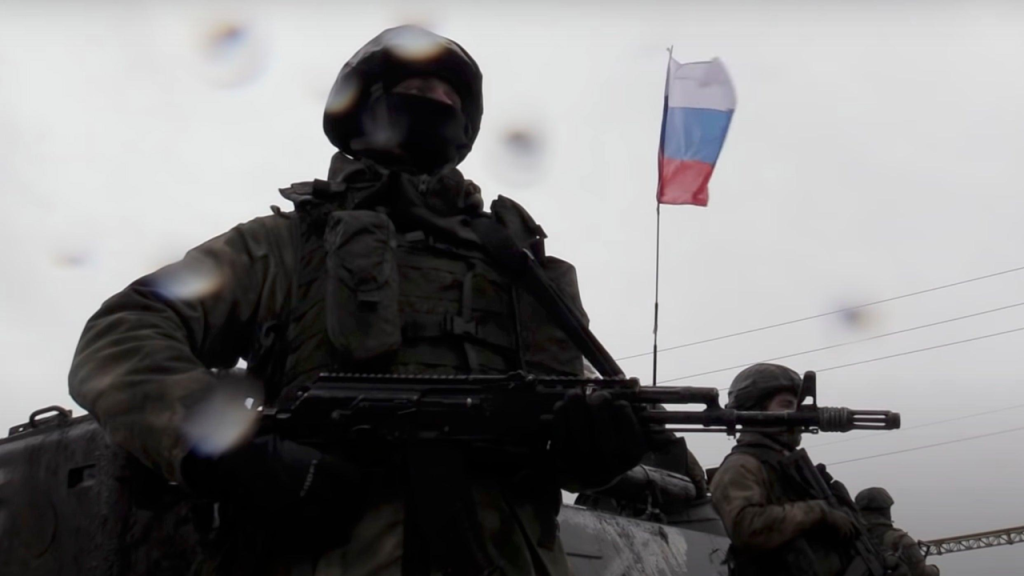
About the photoRussian servicemen guarding a checkpoint in the Luhansk region, Ukraine (EPA) Photo: EPA