Rise to Peace

Reports that Russia may launch a nuclear-armed satellite have revived a danger that is both strategically destabilizing and unusually indiscriminate. NATO chief Mark Rutte said the alliance would defend against threats in space; German Chancellor Friedrich Merz said the reports were serious, while Russia rejected them as unfounded. The claims, attributed in German media to anonymous military and intelligence sources, have not been independently confirmed in the public account. BBC News reported the allegations and the competing responses
The larger lesson is clear even without resolving that dispute: a nuclear explosion in orbit would not stay confined to a military target. It could damage satellite services used by adversaries, allies and the state responsible. Deterrence therefore needs a second pillar: reducing dependence on fragile space infrastructure so that disruption does not turn into civilian crisis or pressure for escalation.
Why an orbital blast would reach beyond its target
Space is not empty of consequences. A nuclear detonation would expose nearby spacecraft to intense radiation, while charged particles trapped by Earth’s magnetic field could continue damaging satellites over time. The effects would depend on the blast’s location and which satellites crossed the resulting radiation belt. A historical test offers a warning, not a precise forecast: the 1962 US Starfish Prime explosion disrupted some Hawaiian streetlights and Pacific radio links, and some satellites failed months later. DW explains the mechanisms and the limits of what can be predicted
Satellite systems perform distinct jobs. Navigation signals help aircraft, ships and phones establish location; satellite communications carry data, including emergency calls from remote places; precise timing supports parts of financial networks. A service can fail indirectly too: an emergency beacon may use one satellite system to determine its position and another to relay the alert. If either link is impaired, rescuers may receive information later.
This is why the risk should not be described as an automatic, uniform blackout. Some satellites might survive; others could be impaired, and the impact would depend on orbit, design and the services affected. But the damage could spread across systems that share the same orbital environment. Debris from collisions could create additional hazards, though whether an explosion would trigger a self-sustaining collision cascade is uncertain.
Deterrence cannot substitute for rules and resilience
The 1967 Outer Space Treaty bars parties from placing nuclear weapons or other weapons of mass destruction in orbit. The 1963 Limited Test Ban Treaty prohibits nuclear explosions in space for its parties. Yet a treaty rule is not the same as a complete verification system: DW notes that the Outer Space Treaty has no dedicated mechanism to inspect what a spacecraft carries, even though a nuclear detonation itself would be detectable by specialized US satellite sensors.
That gap matters because suspicion can itself become a security risk. NATO’s stated position is that it will assess deterrence and defense options; Russia denies the current allegations and has publicly said it opposes deploying nuclear weapons in space. Separately, the BBC reports that the United States and China have pursued or explored other anti-satellite capabilities, and that the US Air Force secretary said the United States had on-orbit “space-control weapons” without describing them. These developments do not establish that the reported Russian plan exists, but they show why rival claims and opaque capabilities can complicate crisis judgments.
Governments should pursue two practical tracks. First, spacefaring states should use diplomatic channels to clarify the treaty prohibition, discuss ways to increase confidence about spacecraft and communicate rapidly when an unusual launch or event raises alarm. The treaty framework offers a starting point, but verification and information-sharing will be politically difficult where states suspect one another of concealing military capabilities. Clearer procedures would not eliminate competition; they could reduce the chance that uncertainty is mistaken for an imminent attack.
Second, satellite operators and civil authorities should identify which essential services depend on particular satellites and test alternatives before an emergency. DW points to shielding, service backups and ground-based navigation aids for some aircraft as possible resilience measures; it also cautions that replacement satellites could face lingering radiation or debris. Redundancy costs money and cannot fully replace global satellite coverage, so priorities should focus on services whose loss would most directly threaten safety, communications or economic continuity.
Protecting civilians starts before a crisis
Nuclear weapons in orbit would be a military choice with consequences extending well beyond the military. The same infrastructure that supports defense also helps civilians navigate, communicate and receive emergency assistance. The credible response is neither to treat an unconfirmed report as proof nor to dismiss the underlying hazard. It is to uphold the prohibition on nuclear weapons in orbit, improve communication that can limit miscalculation, and make essential services less dependent on any single vulnerable space system. That combination offers a more durable form of security than deterrence alone.
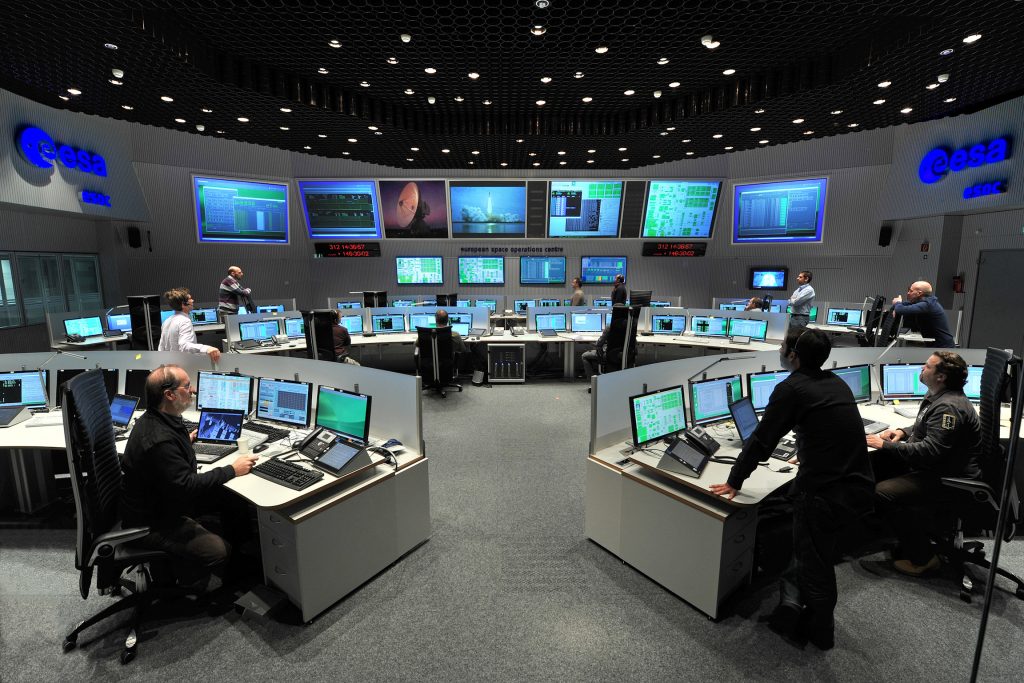
Illustrative photo (not of the events reported). Featured image: European Space Agency / Wikimedia Commons, CC BY-SA 3.0 igo.
Rise to Peace blog #nuclear weapons in space #Research Analysis #rise to peace
About the photoIllustrative photo (not of the events reported): As Europe’s centre of excellence for mission operations, the European Space Operations Centre (ESOC) is home to the engineers who control spacecraft… Photo: European Space Agency / Wikimedia Commons (CC BY-SA 3.0 igo), 7 June 2020. Photo: European Space Agency / Wikimedia Commons