 Rise to Peace
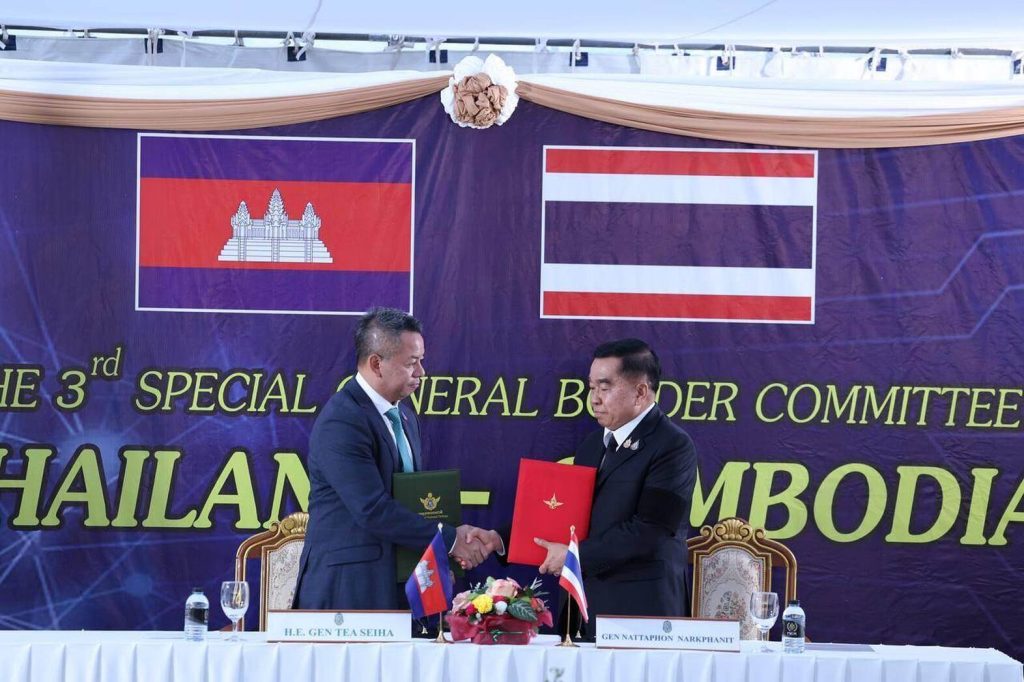

In mid-November, Cambodia and Thailand continued to exchange barbs over their border dispute, with top leaders from both countries engaging in a back-and-forth. The remarks, delivered through media outlets and at regional and international forums, point to a resurgence of diplomatic tensions. There has even been talk that border negotiations may no longer be possible, raising concerns about a protracted border crisis with no clear path to resolution. It has now been a year since the “Kuala Lumpur Peace Agreement,” witnessed by US President Donald Trump, was reached over the land border dispute, yet little to no progress has been made. Regarding the maritime border, both sides have moved toward resolving the dispute through the UNCLOS mechanism, with a follow-up meeting scheduled in Malaysia for late November. Nevertheless, the leaders of both countries have recently adopted increasingly aggressive rhetoric toward one another, with one side even threatening to suspend negotiations entirely.
Notably, during the 20th Francophone Summit, hosted by Cambodia in Phnom Penh from November 14 to 16 and attended by approximately 90 countries, Prime Minister Hun Manet delivered a public address regarding past land border conflicts between Cambodia and Thailand. He stated that Thailand had illegally encroached upon and occupied Cambodian territory, leaving more than 20,000 people unable to return to their homes. He also noted that Cambodia’s Preah Vihear Temple had been damaged by weapons used by the Thai military. In response, Thai Deputy Prime Minister Anutin rejected these claims, urging the international community not to accept Cambodia’s one-sided account. He also called on Cambodia to stop raising border issues before the international community, arguing that doing so would negatively affect bilateral negotiations. A few days later, Chea Thyrith, spokesperson for the President of the Senate, conveyed remarks from Senate President Hun Sen, the Prime Minister’s father, stating that Cambodia would continue raising the issue with the international community. This effectively rejected Thailand’s request, with Hun Sen arguing that Thailand had failed to make progress on land border demarcation over the past year. Shortly thereafter, Thai military intelligence chief Prapas Sornjaidee responded to Hun Sen’s remarks, asserting that they were exacerbating tensions with Thailand and hindering the negotiation process between the two sides.
Meanwhile, in Manila, the Philippines, which hosted the 49th ASEAN Summit from November 15 to 17, Cambodia and Thailand also clashed within the regional forum. During an ASEAN-AIPA meeting, the two sides engaged in a diplomatic war of speech over the ceasefire and Cambodia’s proposals concerning displaced persons. Thailand rejected these proposals, maintaining that it supports a peace mechanism based on bilateral dialogue rather than discussions within a regional forum.
In addition to the land border dispute, Cambodia and Thailand are also negotiating their maritime boundaries under the UNCLOS framework and are scheduled to meet again in Kuala Lumpur from November 24 to 27, 2026. This follows an agreement to establish a joint commission and appoint respective representatives, with the process involving the Permanent Court of Arbitration (PCA). However, the Thai side has frequently asserted that any attempt to force a resolution over the overlapping maritime areas could jeopardize the negotiations. Notably, on November 21, while in Shenzhen for the APEC summit, the Thai Prime Minister indicated that Thailand might halt all negotiations if Cambodia were to employ coercive mechanisms. Thailand prefers direct bilateral discussions without the involvement of third parties or unrelated entities.
Beyond this, at other levels, including discourse in local media in both Thailand and Cambodia, officials and analysts from both sides have frequently engaged in taunting and provocative exchanges over the past year. Both nations have maintained their respective hardline stances, a sentiment reflected in public opinion on social media, where some even suggest that Cambodia and Thailand should sever all ties, including trade and communication, despite sharing hundreds of kilometers of common border.
These factors collectively create further obstacles to resolving the border dispute, causing tensions to escalate day by day. It remains unclear whether there will be any progress in the demarcation process or in resolving the long-standing land and maritime border disputes. Meanwhile, concerns about the potential for armed conflict persist among both experts and the general public.
Overall, the increasingly hostile rhetoric between Cambodia and Thailand reflects a deepening diplomatic rift that threatens to undermine efforts to resolve their long-standing border disputes. Despite previous agreements, regional diplomatic engagement, and ongoing negotiations over both land and maritime boundaries, mutual distrust and uncompromising positions continue to hinder progress. With talks remaining fragile and tensions mounting on both sides, the prospect of a peaceful resolution appears increasingly uncertain. Whether both countries can return to constructive dialogue or allow the dispute to further deteriorate remains a critical question for the coming months, particularly as concerns over renewed armed confrontation continue to grow.
Diplomacy & International Affairs
About the photoTea Seiha, Minister of Defence and Cambodia(Left) with Thai Defense Minister Natthaphon Narkphanit(Right) in the General Border Committee Meeting in Chanthaburi Province, December 27 2025 Photo: AKP(Agence Kampuchea Presse)


