Rise to Peace

Haitian security forces have retaken the country’s main football stadium in Port-au-Prince, ending two years of gang control, according to France 24.France 24 reported Salvadoran troops have taken over security at the venue; El Salvador deployed 2,000 soldiers to Haiti after an ambush in which four of its troops went missing. A video released by Salvadoran President Nayib Bukele showed armed robots during an operation against gangs at the stadium, Al Jazeera reported.Al Jazeera reported
The central lesson is that taking a site back is not the same as protecting the people who live around it. Haiti’s security recovery will depend on whether authorities can hold reclaimed ground, restore a credible state presence and control how security forces use new capabilities. Armed robots sharpen that challenge: their appearance in an operation does not establish what they did, but it makes rules, human responsibility and civilian-harm review urgent questions.
Retaking territory does not end the threat
The stadium operation comes amid severe violence. A United Nations report said at least 1,167 people were killed and 459 injured in Haiti between July and September. Gangs were responsible for more than 45 percent of the incidents recorded, while about five percent were attributed to self-defence groups targeting gang members and people suspected of collaborating with them.UN News summarized the UN human-rights report
The same report warns against treating security operations as automatically protective. More than half of the documented killings and injuries occurred during ground or aerial operations by security forces against gangs, sometimes with support from a private military company using drones. More than 16 percent of victims of security-force operations were not associated with gangs, and four people, including two children, were killed in attacks involving explosive drones. These figures do not show that the stadium operation caused civilian harm. They do show why each operation needs scrutiny based on its effects, not only on whether territory changed hands.
The risk is also that gains do not last. The UN report said gangs driven from Bel Air and La Saline earlier in the year gradually regained a foothold and committed further abuses. A cleared location can become vulnerable again if security forces withdraw, surrounding communities remain exposed, or government services fail to return. A landmark’s recapture can therefore be operationally significant without yet changing the balance of daily safety.
Robotic systems need accountable human control
The public appearance of armed robots raises a governance question, not a reason to assume facts not established about their use. The reports say robots were shown during an operation; they do not establish whether they fired, how they were controlled, or what rules governed them. Those uncertainties matter because equipment can change how quickly force is applied and complicate the public’s ability to identify who made a decision.
Haitian authorities and the Salvadoran forces should clarify the systems’ role, the chain of command and the rules governing any use of force. Any inquiry into civilian injury should preserve evidence and distinguish confirmed facts from claims. These steps can improve accountability and public confidence, but they cannot substitute for competent operations or independent oversight. Foreign partners should also make human-rights compliance and civilian-harm reporting conditions of their support.
The UN report documents 44 cases of extrajudicial executions and attempted extrajudicial executions involving members of the Haitian National Police during the quarter, compared with 14 in the previous quarter. That finding makes oversight a practical security concern as well as a legal one: abuses can erode trust, deter cooperation with authorities and deepen the conditions in which armed groups operate. It does not justify collective suspicion of the police or a claim that every case has been independently adjudicated.
Holding ground means rebuilding state presence
Responsibility ultimately rests with Haitian institutions, even when international forces provide support. The UN representative cited in the report said the massacres underscored the need to strengthen mechanisms for protecting the population and the state’s presence in newly liberated areas. This frames the test beyond the stadium: can people travel, seek help and access essential public services without gangs dictating the terms?
Haitian authorities, supported by international partners, should plan security and civilian protection together: define who holds a recovered area, how residents can report threats or misconduct, and how basic public services and assistance will return. The UN report urges stronger protection and assistance for people affected by violence, and calls for full deployment of the Security Council-authorized Gang Suppression Force in accordance with international human-rights standards. Such support may expand capacity, but deployment alone cannot guarantee durable control; it needs clear accountability and a Haitian-led political and institutional purpose.
Haiti’s stadium is a tangible recovery, but it is not yet proof of a recovery in security. The measure of success will be whether gang control stays broken without exposing civilians to renewed abuse, and whether the state can remain present after foreign troops and advanced equipment draw attention away. Territory is only truly reclaimed when residents gain lasting protection and a credible public authority.
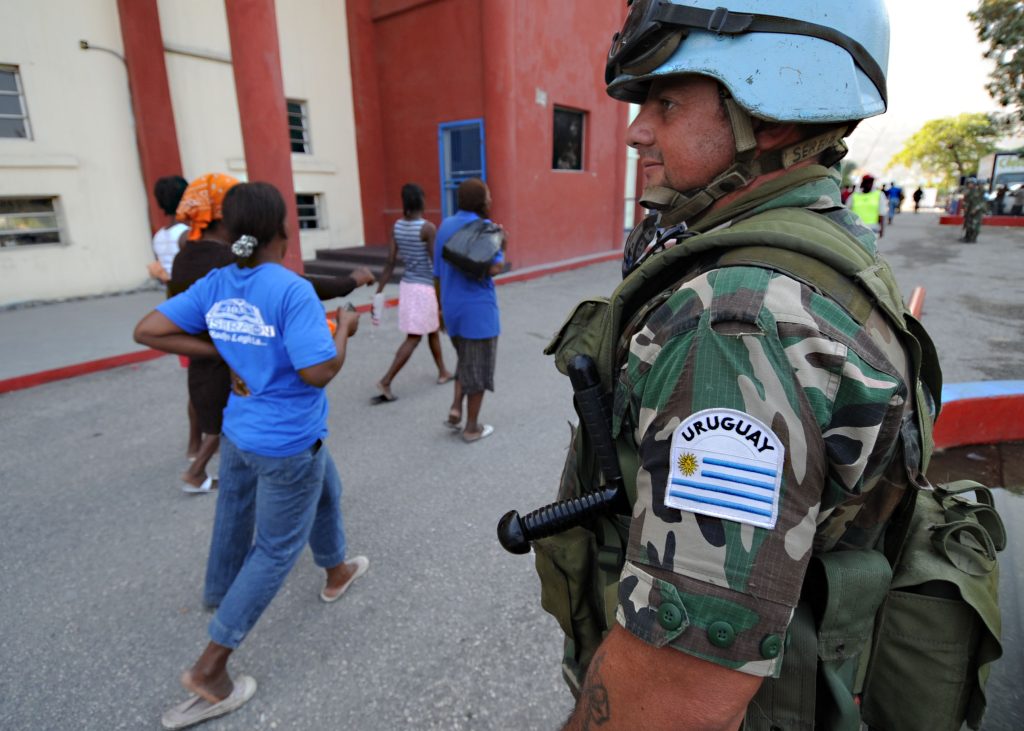
Illustrative photo (not of the events reported). Featured image: MCCS Spike Call / Wikimedia Commons, Public domain.
Rise to Peace blog #Haiti security recovery #Research Analysis #rise to peace
About the photoIllustrative photo (not of the events reported): United Nations Peacekeepers from Uruguay provide security at a food distribution site outside the National Stadium in Port-au-Prince, Haiti, Feb. 16, 2010. Photo: MCCS Spike Call / Wikimedia Commons (Public domain), 3 April 2013. Photo: MCCS Spike Call / Wikimedia Commons