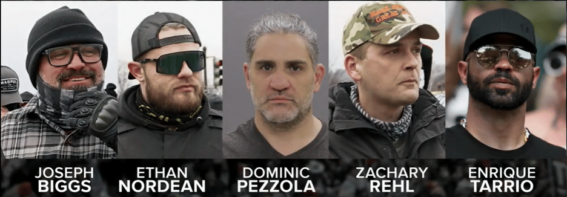
Proud Boy national chairman Henry “Enrique” Tarrio of Miami, Florida; former Proud Boy national chairman Ethan Nordean (“Rufio Panman”) of Auburn, Washington; Joseph Biggs (“Sergeant Biggs”) of Ormond Beach, Florida; Zachary Rehl of Philadelphia, Pennsylvania; and Dominic Pezzola (“Spaz,” “Spazzola”) of Rochester, New York have all been charged with seditious conspiracy for their actions before and during the Capitol Breach on January 6, 2021. Their actions disrupted a joint session of the U.S. Congress convened to ascertain and count the electoral votes related to the 2020 presidential election.
All defendants now face a total of nine charges, and Pezzola faces an additional robbery charge.
Planning and Preparation
In December 2020, Proud Boys’ leadership made a private, encrypted messaging channel known as the Ministry of Self-Defense (MOSD). This private channel was allegedly restricted to several core members and members of the Proud Boys’ leadership, including Enrique Tarrio, Ethan Nordean, Joseph Biggs, Zachary Rehl, and Charles Donohoe. Tarrio explained that MOSD was a “national rallying planning committee.” After forming MOSD, Tarrio and the other leaders immediately began preparations for January 6, 2021.
On December 30, 2020, an individual sent Tarrio a document titled “1776 Returns.” This document outlined a plan to occupy a few “crucial buildings” in Washington, D.C., including the House and Senate Office buildings around the Capitol, with “as many people as possible” to “show our politicians We the People are in charge.”
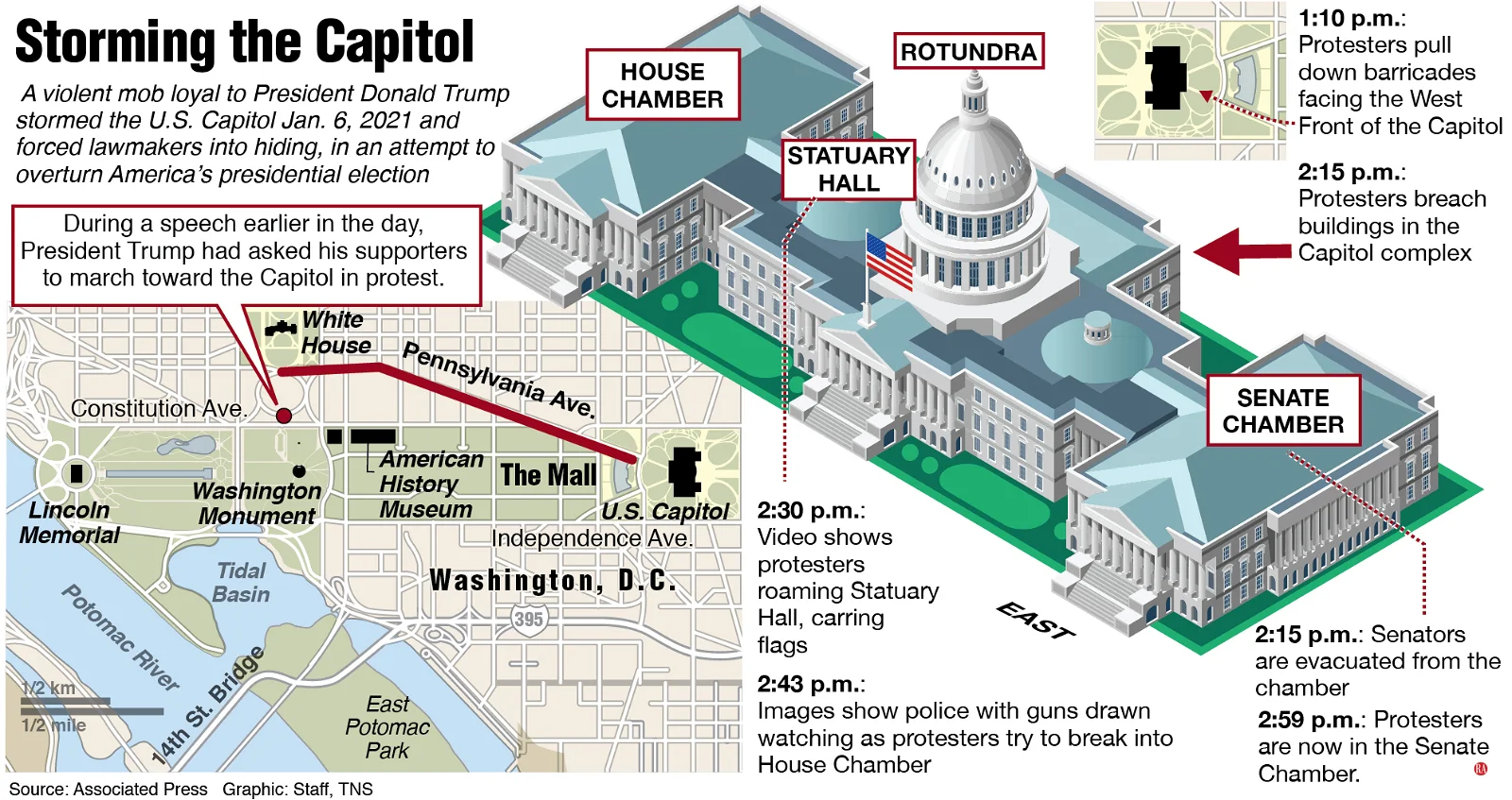
January 6th Proud Boys Timeline
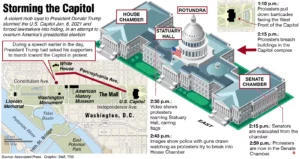
Timeline of the storming of the U.S. Capitol. (Source: Republican American/ AP)
On the morning of the insurrection, the Proud Boys gathered by the Washington Monument. Around 10:00 am, notable members such as Rehl, Biggs, and Nordean gathered near the Washington Monument and then walked to a lawn in an unrestricted area east of the Capitol.
Around 11:30 am, the Proud Boys recongregated on the east lawn of the Capitol with an estimated 100 members.
By 12:45 pm, around the time former President Trump finished his address, the Proud Boys reached a point northwest of the Capitol known as the Peace Monument, where Pennsylvania Avenue intersects the Capitol grounds. The walkway led straight to the steps of the Capitol.
At 12:53 pm, seven minutes before the Joint Session of Congress would be gaveled into session, a man in the crowd known as Ryan Samsel had a conversation with Biggs. Following that conversation, Samsel and a second man identified as Grant James ventured into the restricted area of Capitol Hill, striding up to the outmanned line of five or six Capitol Police officers. They confronted these officers belligerently, then shook and lifted the barrier, toppling it over on top of the officers. A female officer fell back and struck her head on the concrete.
With the first barricade toppled, more than a dozen Proud Boys streamed across it and past the officers, making their way toward the west Capitol steps. Closer to the Capitol, the mob encountered a second barrier. Nordean and Biggs played direct physical roles in tearing down the barrier.
At 1:00 pm, former Vice President Pence tweeted that he viewed his role that day as “ceremonial.” Former Vice President Pence would not unilaterally reject the results of the swing states’ popular elections. Around the same time, former President Trump was nearing the end of his speech at the Ellipse, stating, “if you don’t fight like hell, you’re not going to have a country anymore. We are going to walk down Pennsylvania Avenue—I love Pennsylvania Avenue—and we are going to the Capitol.”
Around 1:37 pm, there was a breakthrough at an impasse at the western base of the Capitol. Proud Boy Dan “Milkshake” Scott was apparently “one of the first, or perhaps the first,” rioter to “initiate contact with law enforcement at this location.” Allegedly, Scott pushed two officers backward, up the Capitol steps, and pulled an officer into the mob.
At 2:13 pm, Pezzola had stolen a police officer’s riot shield, using it to smash out a Capitol window pane as another rioter shattered the adjoining pane with a wooden plank. Pezzola climbed through one of the broken windows.
Each Leader’s Role
These subsequent sections will describe the role each Proud Boys leader played before and during the January 6 attack. Nonetheless, please note that this section is a synopsis and does not include all the evidence against each individual. For complete details, reference the court document and transcript from the January 6 Committee Hearing.
Enrique Tarrio
On November 7, 2020, news networks projected that former Vice President Joe Biden had won the 2020 presidential election. This had immediate implications for the Proud Boys. The same day, Tarrio posted onto the social media platform Parler stating the “standby order has been rescinded,” in reference to the legitimizing event that former President Trump had conferred upon the Proud Boys in late September during a Presidential debate. When former President Trump was asked if he would disavow “white supremacists and right-wing militia,” such as the Proud Boys, Trump responded, “the Proud Boys, stand back, and stand by. But I’ll tell you what. I’ll tell you what — somebody’s got to do something about antifa and the left because this is not a right-wing problem.” After the debate, Tarrio posted, “Standing by, Sir.”
On December 29, 2020, Tarrio posted another message on Parler calling the Proud Boys members to “turn out on record numbers” on January 6, but this time “with a twist.” Tarrio wrote, “we will not be wearing our traditional Black and Yellow. We will be incognito and we will be spread across downtown DC in smaller teams.”
Before Tarrio could join the march to the Capitol, he was arrested on January 4th on charges stemming from violence after a “Stop the Steal” rally one month earlier. He was found to be in felony possession of two high-capacity magazines compatible with AR-15 or M4 assault rifles. Tarrio was released on January 5th and met with the founder and leader of the Oath Keepers, Elmer Stewart Rhodes III.
Ethan Nordean
On November 7, 2020, Nordean posted, “we tried playing nice and by the rules, now you will deal with the monster you created. The spirit of 1776 has resurfaced and has created groups like the Proudboys and we will not be extinguished. We will grow like the flame that fuels us and spread like love that guides us. We are unstoppable, unrelenting and now … unforgiving. Good luck to all you traitors of this county we so deeply love … you’re going to need it.” Earlier that month, Nordean solicited militia groups in the Pacific Northwest to contact him on an encrypted social media application.
On November 27, 2020, Nordean created an online crowdfunding campaign that solicited donations for “protective gear and communications” to be used by the Proud Boys. Nordean shared this crowdsourcing campaign on his social media page and encouraged others to share it.
Joseph Biggs
On December 29, 2020, Biggs posted, “you won’t see us. We are going to smell like you, move like you, and look like you. The only thing we’ll do that’s us is think like us! Jan 6th is gonna be epic.”
On January 5th, the Proud Boys created another encrypted messaging channel on Telegram called “Boots on the Grounds.” Biggs used this channel to urge the Proud Boys to stay out of trouble the day before the insurrection. “Tomorrow’s the day. . . Just trying to get our numbers. So we can plan accordingly for tonight and tomorrow’s plan.” Later, he wrote, “We have a plan.”
Caroline Edwards, a witness in the January 6 Committee Hearing, confirmed Biggs led the crowd. When Biggs began to speak to the crowd, it became more emotionally charged and started to chant statements against Antifa. Biggs then turned his attention towards the Capitol Police and started questioning them, slowly turning the crowd’s attention onto the officers. Caroline Edwards also identified Ryan Samsel talking to Biggs. Once the conversation was over, Biggs and Samsel approached the first barricade, ripped it down, and approached officers.
Zachary Rehl
On November 27, 2020, Rehl posted, “hopefully the firing squads are for the traitors that are trying to steal the election from the American people. Some people at the highest levels need to be made an example of with an execution or two or three.”
On December 30, 2020, Tarrio convened a video call for prospective members of MOSD. MOSD leadership emphasized that members were to follow the commands of leadership. Rehl warned prospective members that January 6 was going to be a “completely different operation” and the Proud Boys would not be conducting a night march.
On December 30, 2020, Rehl posted a link to an online fundraiser with the campaign name “Travel Expenses for upcoming Patriot Events.” This campaign generated over $5,500 in donations between December 30, 2020, and January 4, 2021.
Dominic Pezzola
On December 31, 2020, Tarrio posted a photo of Pezzola from the Stop the Steal protest on December 12 in Washington D.C. Along with the photo, Tarrio posted, “Lords of War. #J6 #J20” in reference to January 6 and January 20, President Joe Biden’s inauguration date.
According to an affidavit, the FBI has spoken to an affiant known as “W-1,” who spoke with Pezzola along with other individuals. In this conversation, Pezzola bragged about breaking the windows to the Capitol by using a Capitol Police shield. “W-1” also detailed conversations with other members who admitted to their acts on January 6 and what they would have liked to accomplish, including killing Nancy Pelosi and former Vice President Mike Pence if given the chance.
The Impact of the Proud Boys in the U.S.
Professor Rober A. Page,with his colleagues in the Project on Security and Threats from the University of Chicago, has been tracking insurrectionist sentiments in U.S. adults since June 2021. They found that 47 million U.S. adults agreed with the statement that “the 2020 election was stolen from Donald Trump and Joe Biden is an illegitimate president.” Of those 47 million, 21 million agreed with the statement that “use of force is justified to restore Donald Trump to the presidency.” Many of these 21 million survey participants with insurrectionist sentiments have the capacity for violent mobilization. Of the 21 million, 6 million stated they supported right-wing militias and extremist groups, and one million stated they are themselves or personally know someone to be a member of a group, such as the Proud Boys or the Oath Keepers.
Although a small percentage of people who hold extremist views commit an act of violence, the findings in this survey reveal how many Americans hold certain perspectives which can lead toward insurrection.
A 2021 report published by the Southern Poverty Law Center found that while the number of active hate groups in the U.S. has declined, the Proud Boys’ membership has increased. The Proud Boys gained 29 chapters in one year and now have 72 chapters nationwide.
The growth in membership may suggest that the current political and social climate in the U.S. have become a fertile ground for the Proud Boys’ brands of authoritarian politics.
The Proud Boys became something few have expected, a hegemonic force for the far-right who are able to appeal to mainstream conservatives, carving out a space for white nationalists and fascists. Their moderate strategies have won them greater appeal by foregrounding ultranationalism and a vicious opposition to left-leaning politics. Inching closer and closer to American mainstream conservatism has made the Proud Boys a dangerous force as they have garnered sympathetic media coverage. It is not a coincidence that the Proud Boys’ uniform features black and yellow shirts from Fred Perry, a favored skinhead brand.
What Can Be Done?
According to the 2021 Southern Poverty Law Center report, the criminal legal system solely cannot address the spread of far-right extremism. Since a majority of groups concentrate on influencing mainstream politics, diverse communities must work together to help build resiliency through prevention, organization, and education.
With a group such as the Proud Boys who, over time, have become hardened and have lost their empathy, these suggestions may not be received well by members with violent tendencies. It takes time and adjustment to unravel all the hate, apathy, and anger cultivated by their initiation rituals. Psychologists and experts in sociology, criminology, and political science have identified deradicalization and disengagement strategies. The German non-profit, the Violence Prevention Network has begun to work in Pittsburgh to launch operations for more intervention programs in the U.S.
Christian Picciolini is a former neo-Nazi turned activist who, for two decades, helped individuals leave extremism through his disengagement work and organization, the Free Radical Project. Picciolini states that people join extremist groups because of life’s “potholes,” incidents of trauma or neglect which affect people and lead them to join extremist groups as they search for an identity, community, and purpose.
“So when I engage with people to help them to leave these movements, I never debate them ideologically,” said Christian Picciolini, “I don’t tell them that their ideas are wrong, even though of course, I know that they are. But what I do is I listen, and I listen for those potholes so that I can find ways to fill them in.”
It is never an easy task to convince someone why their beliefs are wrong and to not hate them for it, but taking the time to realize they are still human and have universal needs to be recognized as such is the first step. At times, it’s necessary to show someone humanity when they may not recognize your own.
Camille Amberger, Counter-Terrorism Research Fellow